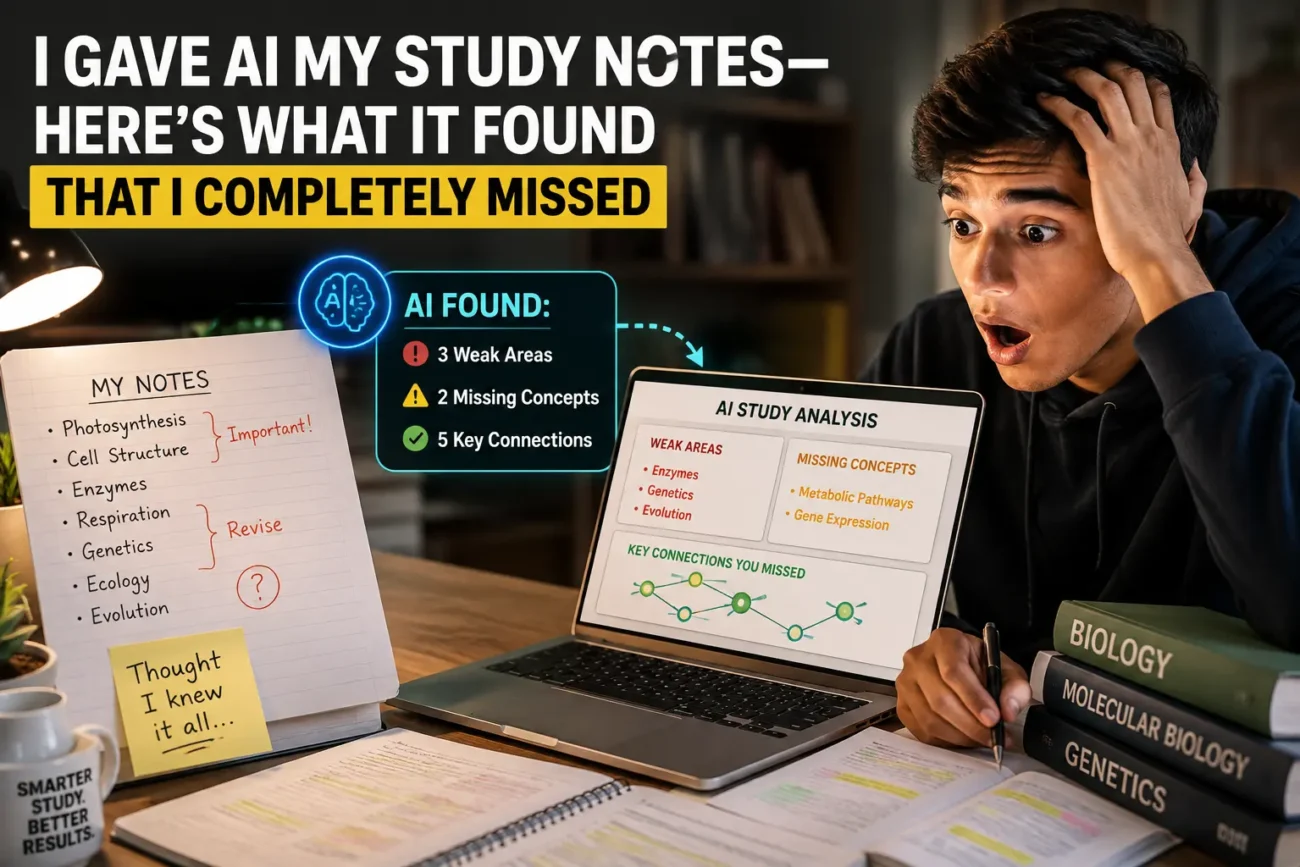
I thought I knew my study material pretty well. My notes were organized, the important sections were highlighted, and I had already read through them more than once. But reading something and actually being able to explain it from memory are two very different things. So I decided to see what would happen if I gave my AI study notes and asked it to do something more useful than simply summarize them.
The first thing I noticed was that AI didn’t magically make me smarter. What it did do was expose places where my notes looked complete but my understanding wasn’t. It found concepts that were mentioned but never properly explained, connections between topics that I hadn’t noticed, and areas where I could recognize an answer but couldn’t produce one myself.
That made the experiment much more interesting than another AI-generated summary.
Instead of asking AI, “Summarize my notes,” I started asking it to challenge what I actually knew.
Why I Stopped Asking AI to Just Summarize My Notes
AI summaries are convenient.
You paste your notes into a chatbot, ask for a shorter version, and within seconds you have a neat list of key points.
The problem?
You can read that summary and feel like you understand everything.
That feeling can be misleading.
For example, imagine your notes contain:
- Definition of a concept
- Three important characteristics
- A process with five steps
- Several examples
- A comparison with another concept
After reading everything, it feels familiar.
But if someone closes your notes and asks:
“Explain the process without looking.”
Suddenly, step four disappears.
That’s where active recall becomes useful. Instead of asking AI to give information back to you, you ask it to make you retrieve the information yourself.
This is also why I think the workflow works particularly well alongside AI active recall study prompts.
What I Asked AI to Do With My Notes
I started with a simple instruction.
“Analyze these study notes as if you were helping me prepare for an exam. Don’t summarize them yet. Instead, identify concepts that are unclear, incomplete, poorly connected, or likely to cause confusion during a test.”
That changed the entire interaction.
Instead of producing another version of my notes, AI started looking at them from the perspective of a learner preparing for questions.
Then I asked it to categorize what it found.
I used four categories:
- I probably know this
- I recognize this but may not be able to explain it
- I need to review this
- I don’t understand this properly yet
That simple classification was surprisingly useful.
And it led to seven things I would now ask AI to look for whenever I have a large set of study notes.
7 Things AI Can Find in Your Study Notes
1. Concepts You Mentioned but Never Actually Explained
This was one of the most useful checks.
Students often write notes assuming that a keyword will remind them of everything discussed in class.
For example:
“Photosynthesis → light-dependent reactions → ATP → NADPH.”
It looks like a perfectly reasonable note.
But what if you can’t explain:
- What happens during the reaction?
- Why ATP is produced?
- Where NADPH fits in?
- How the process connects to the next stage?
The note contains the keywords.
The understanding may not be there.
Try this prompt:
“Look through these notes and identify concepts that are mentioned but not sufficiently explained. For each one, explain what information appears to be missing and give me one question I should be able to answer to prove that I understand it.”
That’s much more useful than asking for a summary.
2. AI Can Find Topics That Look Familiar but Are Weak
This one is easy to overlook.
Sometimes I can read a paragraph and think:
“Yeah, I know this.”
But recognition isn’t necessarily recall.
So I would ask:
“Based only on these notes, identify topics that a student might recognize while reading but struggle to explain without looking at the material. Don’t give me the answers. Give me questions that test whether I genuinely understand each topic.”
Now AI is turning passive familiarity into a test.
For example, instead of:
“The mitochondria produces ATP.”
AI might challenge you with:
“Explain how mitochondria contribute to ATP production and why the process depends on the conditions described in your notes.”
That’s a much harder test.
And that’s exactly what you want before an exam.
3. It Can Find Connections Between Topics You Missed
This was another useful angle.
Notes are often written sequentially:
Topic A → Topic B → Topic C
But exams don’t always work that way.
A question might combine A and C.
So I ask:
“Find important connections between different sections of these notes. Give me five relationships between concepts that I should understand, and explain why each connection could matter in an exam.”
This can reveal relationships you might not have explicitly written down.
For example:
Concept A affects Concept B.
Then:
Concept B changes the outcome of Concept C.
That creates a chain:
A → B → C
Once you see that relationship, the material becomes easier to reason about rather than memorize as disconnected facts.
4. AI Can Find Missing Examples
Sometimes notes explain a concept but don’t show what it looks like in practice.
That’s dangerous because you might know the definition but not recognize the concept when it appears in a question.
Try:
“Identify important concepts in these notes that don’t have a concrete example. Give me one realistic example for each and then create a question that asks me to apply the concept to a new situation.”
This turns a definition into an application exercise.
For difficult subjects, this can be much more useful than reading another explanation.
5. It Can Turn Your Weak Sections Into Questions
This is where the workflow becomes much more personalized.
After reviewing the notes, I would take the weak areas and ask:
“Create 15 questions based only on the concepts identified as weak. Don’t show the answers yet. Mix short-answer, why/how, comparison, and scenario-based questions.”
Then answer them without looking at the notes.
This is the important part.
Don’t immediately ask AI:
“What’s the answer?”
Try answering first.
Then use:
“Compare my answers with the material. For each incorrect or incomplete answer, tell me exactly what I misunderstood or left out. Don’t rewrite my answer completely; explain the missing reasoning.”
Now AI becomes a feedback tool rather than an answer machine.
If you’re already using AI to find study gaps, this is a natural next step.
6. AI Can Find Where Your Notes Are Too Complicated
Not every problem comes from missing information.
Sometimes the notes themselves are difficult to understand.
Long sentences, unexplained abbreviations, technical terminology, or badly organized sections can make revision harder than it needs to be.
Try:
“Review these notes for confusing explanations, unexplained terminology, unnecessary complexity, and sections that could be misunderstood. Don’t rewrite everything. Identify only the parts that need clarification and explain why.”
This is particularly useful with:
- Lecture transcripts
- Quickly written class notes
- Notes copied from presentations
- Technical subjects
- Dense textbook material
If the AI identifies a confusing section, you can then ask it to explain that specific section, rather than asking it to simplify your entire course.
7. It Can Tell You What You Should NOT Spend More Time Studying
This might be the most practical part.
Students often spend equal time on every chapter.
But if you already understand one concept extremely well, spending another 45 minutes rereading it probably isn’t the best use of your time.
Ask:
“Based on my answers and these study notes, divide the material into three groups: strong understanding, needs review, and high priority. Explain why each topic belongs in its category.”
Then build your next study session around the weak areas.
This is where AI can work nicely with an AI study schedule.
Instead of:
Study everything → hope you’re prepared
you get:
Test → identify weak areas → prioritize → review → test again
That’s a much more deliberate process.
The Prompt I Would Save
After experimenting with different approaches, I’d keep one master prompt that combines most of these checks:
“Analyze these study notes as a learning coach, not as a summarizer. Identify concepts that are incomplete, confusing, weakly connected, overly dependent on memorization, or missing practical examples. Then create a prioritized list of what I should review. After that, create active-recall questions for the weak areas, but don’t show the answers until I attempt them. When I answer, evaluate my reasoning and identify exactly what I misunderstood or missed. Don’t simply rewrite my notes for me.”
That’s a much better starting point than:
“Summarize these notes.”
What AI Got Wrong in My Workflow
There is one thing I wouldn’t ignore.
AI can be confidently wrong.
It may:
- Misinterpret your notes
- Add information that wasn’t in your material
- Assume something is missing when it isn’t
- Create a question based on an incorrect interpretation
- Give an incorrect explanation
That’s why I wouldn’t use AI as the final authority for important academic information.
My preferred workflow is:
Original material → AI analysis → Your answer → AI feedback → Verify important facts
If something matters for an exam, check it against your textbook, lecture material, instructor’s resources, or another reliable source.
The goal is to use AI to challenge your learning, not replace your learning.
My 20-Minute AI Study Notes Workflow
If you don’t want to spend an hour building a complicated system, here’s a simpler approach.
Step 1 — Give AI your notes
Use the original notes instead of asking AI to summarize them first.
Step 2 — Find the gaps
Ask AI to identify unclear, incomplete, weak, or poorly connected concepts.
Step 3 — Pick your top three weak areas
Don’t try to fix everything at once.
Step 4 — Generate questions
Ask for 5–10 questions per weak area.
Step 5 — Close the notes
Answer from memory.
Step 6 — Get feedback
Give AI your answers and ask it to identify missing reasoning.
Step 7 — Retest
Ask for new questions about the concepts you got wrong.
That’s it.
You don’t need an elaborate AI-powered study system.
Don’t Let AI Do the Studying for You
There’s a temptation to keep giving AI more work:
“Summarize this.”
“Make flashcards.”
“Explain this.”
“Make a study guide.”
“Give me the answers.”
Eventually, you can end up spending more time reading AI-generated material than actually remembering anything.
That’s backwards.
AI should make you work harder at the right moments.
For example:
Bad workflow:
Notes → AI summary → Read → AI explanation → Read → Done
Better workflow:
Notes → AI identifies gaps → You answer questions → AI checks answers → You review mistakes → You retest
That difference matters.
If you want to create flashcards too, you can combine this with making flashcards from a PDF with AI, but don’t let flashcard generation replace actually testing yourself.
Final Takeaway
The biggest lesson from working with AI study notes isn’t that AI can summarize material quickly. We already know it can do that.
The more interesting use is asking AI to find what you don’t know.
It can help identify concepts that you only recognize, connections you haven’t made, explanations that aren’t complete, examples you haven’t considered, and topics where your answers fall apart when the notes disappear.
But there’s a catch: you have to attempt the questions yourself.
If AI gives you every answer before you think, you’re mostly consuming information. If AI asks the questions, you retrieve the information, and then use its feedback to correct your mistakes, you’re actually practicing.
That’s the workflow I’d use: AI study notes → identify gaps → active recall → feedback → targeted review → retest. The AI does the preparation and analysis; you do the remembering.
FAQs
Can AI analyze my study notes?
Yes. You can provide your notes and ask AI to identify unclear concepts, missing information, weak connections, confusing sections, and areas that need more practice.
What should I ask AI to do with my study notes?
Don’t only ask for a summary. Ask AI to identify knowledge gaps, create active-recall questions, find connections between concepts, generate application questions, and evaluate your answers.
Can AI find what I don’t understand?
It can help identify likely weak areas, but it cannot directly know what you understand. The best approach is to combine AI analysis with questions that require you to answer without looking at your notes.
Should I trust AI-generated study material?
Not blindly. AI can make factual and interpretation errors. For important academic information, verify answers against your original course material or another reliable source.
Is using AI to summarize notes enough for studying?
No. A summary can make material easier to review, but it doesn’t necessarily test whether you can retrieve or apply what you learned. Active recall and practice questions can make the process more active.
