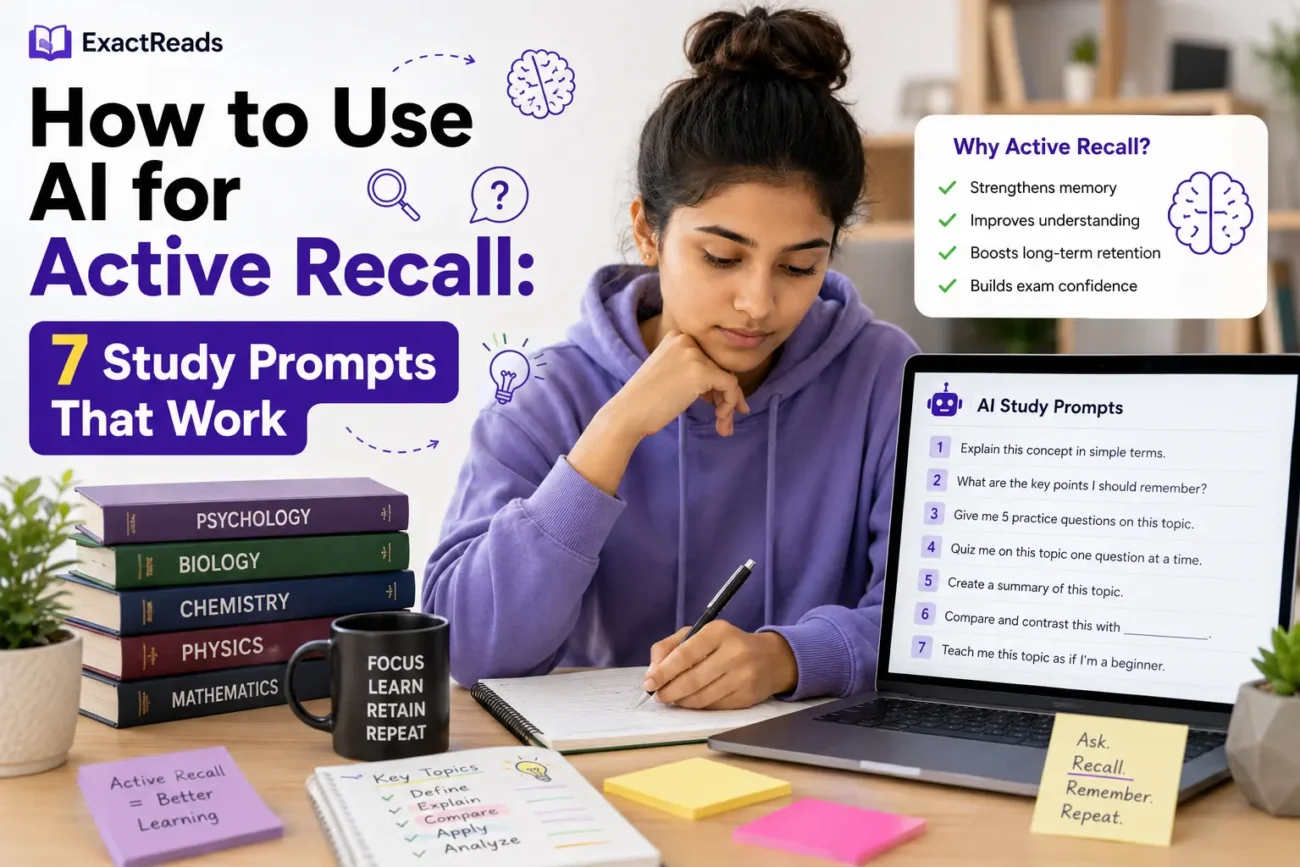
Studying by repeatedly reading the same notes can feel productive, but recognition is not the same as remembering. AI active recall can make study sessions more effective by turning your existing notes, textbook material, or lecture content into questions that force you to retrieve information from memory.
Active recall is simple: instead of looking at an answer and trying to recognize it, you attempt to produce the answer yourself. AI can make that process easier by generating questions, changing difficulty levels, identifying weak areas, and creating different types of practice from the material you already have.
If you are already using AI to create study schedules or turn notes into quizzes, active recall can be the next step. For example, you can combine it with a structured AI study schedule to decide when to review each topic rather than simply studying everything again from the beginning.
What Is Active Recall?
Active recall is a study technique where you deliberately retrieve information from memory instead of passively reviewing it.
For example, suppose you are studying biology and your notes say:
Photosynthesis converts light energy into chemical energy.
Passive study means reading that sentence several times.
Active recall means closing your notes and asking:
“What does photosynthesis convert light energy into?”
You then try to answer without looking.
That small change makes your brain retrieve the information instead of simply recognizing familiar words.
AI can help create hundreds of these retrieval opportunities from material you have already studied.
How AI Can Help With Active Recall
AI is particularly useful for preparing the material you need to practice.
You can provide:
- Class notes
- A textbook section
- A PDF
- Lecture transcripts
- Your own summaries
- A study guide
- A list of important concepts
Then ask the AI to transform that material into different types of questions.
This works especially well alongside AI tools for students because the goal isn’t simply to generate more study material. The goal is to make your existing material more interactive.
7 AI Active Recall Prompts to Try
1. Turn Your Notes Into Retrieval Questions
This is one of the simplest ways to start.
Try this prompt:
Prompt:
“Turn these study notes into 15 active recall questions. Don’t show the answers immediately. Mix easy, medium, and difficult questions. Focus on concepts I need to remember rather than minor details.”
Then answer each question without looking at your notes.
Only check the answers afterward.
This is much more useful than asking AI to simply summarize the same notes again.
2. Ask AI to Quiz You One Question at a Time
You can turn an AI chatbot into an interactive quiz partner.
Use:
“Quiz me on this material one question at a time. Don’t reveal the answer until I respond. After each answer, tell me whether I’m correct, explain what I missed, and then give me the next question.”
This creates a simple feedback loop:
Question → Your answer → Feedback → Next question
It also prevents you from accidentally seeing all the answers before attempting the questions.
For an even better challenge, tell the AI to avoid repeating questions you already answered correctly.
3. Ask for Questions Based on Your Weak Areas
This is where AI can become more useful than a basic question generator.
After completing a quiz, give the AI your incorrect answers.
Then ask:
“Analyze my incorrect answers and identify the concepts I seem to misunderstand. Create 10 new active recall questions focused only on those weak areas. Increase the difficulty gradually.”
Now you’re not spending equal time on everything.
If you already use AI to find study gaps, you can combine the two approaches:
Find the weak topic → Generate targeted recall questions → Retest yourself.
That creates a much more personalized study loop.
4. Turn a Difficult Concept Into “Explain From Memory” Questions
Multiple-choice questions are useful, but they don’t always show whether you genuinely understand something.
For difficult topics, ask AI to generate explanation-based questions.
For example:
“Give me 7 questions that require me to explain this topic in my own words. Don’t use multiple choice. After I answer, identify any missing concepts or incorrect reasoning.”
This works particularly well for:
- Biology
- History
- Economics
- Psychology
- Computer science
- Business
- Science subjects
Instead of recognizing the correct answer, you have to construct the explanation yourself.
5. Create “Why” and “How” Questions
One weakness of simple flashcards is that they can encourage memorizing isolated facts.
You can ask AI to create deeper questions:
“Turn these notes into active recall questions that mostly begin with why, how, compare, explain, or what would happen if. Focus on relationships between concepts.”
For example, instead of:
“What is inflation?”
you might get:
“Why can high inflation reduce purchasing power?”
Or instead of:
“What is photosynthesis?”
you could ask:
“How would reduced sunlight affect the process of photosynthesis?”
These questions require more than simple definition recall.
If flashcards are more suitable for your material, you can also combine this approach with making flashcards from a PDF with AI.
6. Use AI to Create a “No-Notes” Mini Test
Before an exam, don’t immediately ask AI for another summary.
Instead, try:
“Create a 20-question closed-book test from this material. Don’t show answers until I finish. Include 5 basic questions, 10 application questions, and 5 difficult questions. After I submit my answers, score them and identify my three weakest topics.”
Then put your notes away.
Complete the test without assistance.
Afterward, use your score to determine what deserves another study session.
You can also use this method with an AI-powered study guide when preparing for a larger exam.
7. Ask AI to Retest You Later
One of the biggest mistakes students make is testing themselves once and then assuming the topic is mastered.
Instead, save the questions you got wrong.
Later, ask:
“Retest me on the questions I previously got wrong. Don’t repeat the exact wording. Change the question format and test whether I can still retrieve the concept.”
For example, an original question could be:
“What are the three stages of cellular respiration?”
A later version could ask:
“Put the major stages of cellular respiration in the correct sequence and briefly explain what happens in each.”
The concept remains the same, but the question is different.
How to Use AI Active Recall Without Becoming Dependent on AI
AI should help you practice remembering, not do the remembering for you.
That’s an important distinction.
If AI gives you a question and you immediately ask it for the answer, you have skipped the most important part of active recall.
Instead:
- Read the question.
- Put the AI response out of sight if possible.
- Answer from memory.
- Compare your response with the explanation.
- Record what you missed.
- Review the weak concept.
- Test yourself again later.
This keeps the student—not the AI—in control of the learning process.
It also fits well with the broader principle behind using AI as a study tutor: AI can provide feedback and practice, but the learner still needs to think, retrieve, evaluate, and correct their own understanding.
A Simple 20-Minute AI Active Recall Routine
You don’t need an elaborate system.
Try this:
Minutes 1–5: Prepare
Give your notes or study material to the AI and ask for 10–15 questions.
Minutes 5–12: Recall
Answer the questions without looking at your notes.
Minutes 12–15: Check
Review the AI’s feedback and mark the questions you missed.
Minutes 15–18: Fix
Ask AI to explain only the concepts you got wrong.
Minutes 18–20: Retest
Ask for three new questions covering those weak areas.
You can then add the weak topics to your next study session.
Common Mistakes When Using AI for Active Recall
Asking for answers too early
If you see the answer before attempting the question, you lose much of the retrieval challenge.
Generating too many questions
More questions aren’t automatically better. Ten useful questions can be more valuable than 100 repetitive ones.
Accepting every AI explanation
AI can make mistakes. Check important facts against your textbook, lecture material, or reliable academic sources.
Only using multiple-choice questions
Mix formats. Use short answers, explanations, comparisons, application questions, and scenario-based questions.
Repeating the exact same questions
Change the wording and format so you test genuine understanding rather than memorizing the answer pattern.
Using AI instead of studying
AI should make your study process more active—not make the studying itself disappear.
The Best Way to Combine AI With Active Recall
The strongest workflow isn’t simply:
Notes → AI summary → Read summary
A better workflow is:
Notes → AI questions → Recall → Feedback → Identify weak areas → Retest
You can combine that with your existing AI study workflow:
Study schedule → AI-generated questions → Active recall → Weak-area analysis → Flashcards → Retest
This approach also connects naturally with AI note-taking for students because your notes become the starting material rather than the final study product.
Final Thoughts
AI active recall is most useful when you make the AI challenge your memory instead of constantly giving you information. Ask it to create questions, wait before viewing answers, explain mistakes, increase difficulty, and retest the concepts you struggle with.
The goal isn’t to spend more time chatting with an AI tool. The goal is to spend more time retrieving, explaining, applying, and correcting what you actually know.
Used that way, AI becomes a study partner rather than a shortcut—and your study sessions can become more targeted, interactive, and efficient.
FAQs
Is AI good for active recall?
Yes. AI can generate retrieval questions, quizzes, explanations, and follow-up tests from your study material. The important part is attempting to answer before seeing the AI’s response.
What is the best AI prompt for active recall?
A useful starting prompt is: “Turn these notes into 15 active recall questions. Don’t show the answers until I respond. Mix easy, medium, and difficult questions.”
Can AI create active recall questions from a PDF?
Yes. You can provide the relevant PDF content to an AI tool and ask it to create questions based on the material. Always verify important information against the original source.
Is active recall better than rereading?
For many learning situations, active recall is more useful than repeatedly rereading because it requires you to retrieve information rather than simply recognize familiar text.
How often should I use AI for active recall?
Use it regularly during study sessions, but focus on quality rather than generating huge numbers of questions. Retesting topics you previously got wrong is especially useful.
