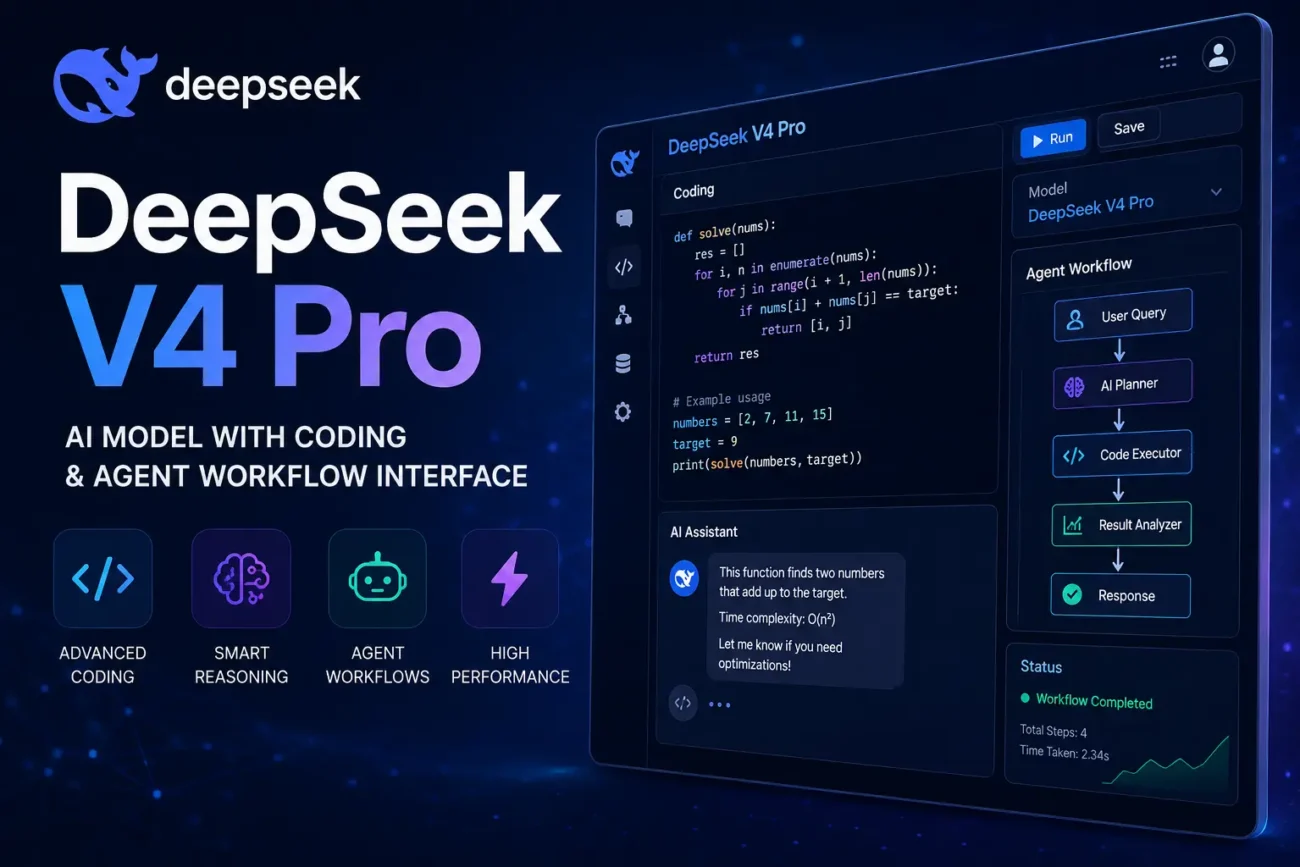
DeepSeek V4 Pro is officially here, and this release is more interesting than a typical model refresh.
The general-availability version rolled out on August 13, 2026, across DeepSeek’s web, app and API. The launch is especially notable because DeepSeek is positioning V4 Pro around agentic coding, tool use, long-context work and multi-step tasks, rather than simply trying to win another chatbot benchmark.
I also think the timing matters. Just one day after launch, DeepSeek announced another pricing change that will alter the economics of using V4 Pro through its API. So anyone reading old launch-day coverage can easily end up with outdated pricing information.
That is why this article isn’t just another “DeepSeek V4 Pro is better” announcement.
Let’s look at what actually changed, what the model is built for, where the evidence is strong, where we should be cautious, and whether switching makes sense.
DeepSeek V4 Pro: The Quick Answer
DeepSeek V4 Pro is a 1M-context mixture-of-experts model aimed heavily at coding, reasoning, long documents and AI-agent workflows. DeepSeek’s V4 family documentation lists 1.6 trillion total parameters with 49 billion activated parameters for V4 Pro, along with a 1 million-token context window and support for both thinking and non-thinking modes.
It is available through:
- DeepSeek’s web experience
- DeepSeek’s app
- The API
and the API supports tool calls and structured JSON output.
My quick verdict
Worth testing: developers, AI-agent builders, heavy document users, researchers, and teams running high-volume model workloads.
Don’t switch blindly: casual users who already have a model that works well for their everyday needs.
The interesting question isn’t “Is DeepSeek V4 Pro the best AI?”
It’s:
Is it better for the work you actually do?
We’re launching DeepSeek-V4-Pro today! 🚀
🔷 Major Agent upgrades with strong production gains!
🔷 Flexible reasoning effort for V4-Pro & V4-Flash: low for simple tasks, high for daily Agent workflows, max for complex tasks.
🔷 Native OpenAI Responses API support, optimized for… pic.twitter.com/ZsGbUpiu1T— DeepSeek (@deepseek_ai) August 13, 2026
What Is DeepSeek V4 Pro?
DeepSeek V4 Pro is the higher-end model in the DeepSeek V4 family.
DeepSeek introduced the V4 family in April as an open-weight, 1M-context generation with two main variants: V4 Pro and V4 Flash. The company described Pro as the more capable model for reasoning and agentic tasks, while Flash was designed to be smaller and more economical.
The architecture is also worth noting.
DeepSeek describes V4 Pro as a Mixture-of-Experts (MoE) model with approximately 1.6T total parameters but 49B activated parameters. That means the model does not use the full parameter count for every token in the same way a dense model would.
You don’t need to understand the architecture to use the model, but the distinction matters when people casually compare “1.6T parameters” with parameter counts from other models.
The useful takeaway is simpler:
DeepSeek is trying to get very large-model capability without making every inference pay the cost of activating everything.
Why the 1M Context Window Matters
One of the biggest practical features of DeepSeek V4 Pro is the 1 million token context window.
That is enormous.
It means the model can potentially work with very large amounts of material in a single context instead of forcing you to split everything into many smaller conversations.
DeepSeek says its V4 architecture uses compressed sparse attention and related efficiency techniques to reduce compute and memory requirements for long-context inference. Its technical documentation also reports substantial efficiency gains compared with V3.2 in a 1M-token setting.
For real users, that opens up interesting workflows:
- Large technical documentation
- Long research projects
- Large codebases
- Business documents
- Multi-file analysis
- Large specifications
- Long-running agent sessions
But there is a catch.
Bigger context doesn’t automatically mean better answers.
A model can technically accept a huge amount of material and still fail to use the right part of it.
So I would evaluate the feature based on retrieval quality and reasoning across the context, not the “1M” number itself.
What Changed in the Official V4 Pro Release?
The April V4 preview already introduced many of the headline capabilities.
The August 13 GA release is the important step because this is the production release users can actually evaluate against competing models now. Reuters reported the official launch and noted that the finalized V4 Pro showed a substantial improvement over the earlier preview in independent evaluation.
DeepSeek’s V4 family is centered around:
- Agentic coding
- Reasoning
- Long-context understanding
- Tool use
- Structured output
- Multi-step workflows
- Compatibility with common API interfaces
DeepSeek also designed the family to work with agent products such as Claude Code, OpenClaw and OpenCode.
That should give you a good idea of where DeepSeek sees the opportunity.
It’s not only trying to answer your questions.
It’s trying to participate in a workflow.
DeepSeek V4 Pro for Coding
Coding is probably the most interesting use case to test first.
DeepSeek says V4 Pro is optimized for agentic coding, and the company has emphasized performance on coding and software-engineering tasks since the April preview.
But there’s an important distinction between:
“Can generate code”
and:
“Can work through a real software task.”
The second one is much harder.
A real coding agent might need to:
- Understand a repository.
- Find the relevant files.
- Inspect dependencies.
- Plan a change.
- Make edits.
- Run tests.
- Read failures.
- Correct the implementation.
- Run tests again.
- Produce a final patch.
That’s why agent-oriented benchmarks matter more here than simple code-generation demos.
DeepSeek has explicitly targeted V4 Pro at this kind of multi-step workflow.
And that is one of the areas where I’d personally spend time testing it before deciding whether the model is genuinely better.
DeepSeek V4 Pro and AI Agents
This is where the release gets more interesting than the average chatbot launch.
A normal chatbot interaction is:
Prompt → Answer
An agent workflow is:
Goal → Plan → Tools → Action → Observation → Correction → Completion
That second workflow is where models can become useful for real automation.
DeepSeek says V4 Pro has enhanced agent capabilities and supports tool calling, while the V4 family was specifically adapted for agent products and coding workflows.
For example, an AI agent could potentially:
- Read a specification
- Search a project
- Modify code
- Run a tool
- Inspect the result
- Fix an error
- Continue until the task is complete
The quality of that loop matters more than how impressive the first response looks.
That’s the area I’d watch most closely as V4 Pro gets used in production.
DeepSeek V4 Pro for Long Documents
The 1M context makes V4 Pro especially interesting for document-heavy work.
Imagine giving a model:
A 500-page technical document
instead of manually splitting it into dozens of smaller chunks.
Potential applications include:
Research
Compare multiple long papers or reports.
Business
Review large policy or operational documents.
Development
Analyze large codebases or documentation sets.
Education
Work through a large collection of course materials.
This also connects with the kind of LLM SEO work where understanding large amounts of structured information and producing consistent outputs matters.
But again, a large context window is not a guarantee of perfect reasoning.
I would test questions where the answer is buried deep in the material, where multiple pieces of the document need to be connected.
That tells you whether the context window is actually useful.
DeepSeek V4 Pro Pricing: Read This Carefully
This is one part of the launch where date matters.
At the August 13 launch, Reuters reported API pricing of:
- $1.32 per 1 million input tokens
- $3.96 per 1 million output tokens
That’s significantly higher than V4 Flash.
However, DeepSeek announced another pricing change on August 14, with peak/off-peak pricing planned and substantial increases for some usage windows. Reuters reported that those changes would take effect on August 17, while other reporting says peak pricing for V4 Pro will rise to roughly $3.96 per million output tokens and prices will vary depending on when the API is used.
So don’t copy a static “DeepSeek V4 Pro costs X” figure into an article and leave it untouched.
Pricing is moving right now.
Before buying API credits, check DeepSeek’s current pricing page for the latest schedule.
This is one reason I would separate:
model capability
from:
model economics
A model can be excellent and still become a worse choice for a very high-volume application if the price changes.
Is DeepSeek V4 Pro Actually Better Than V4 Flash?
The finalized Pro is clearly positioned above Flash.
Reuters reported that independent evaluation from Artificial Analysis gave V4 Pro an Intelligence Index score of 53, compared with 40 for V4 Flash, with the evaluation considering areas such as coding, tool use and scientific reasoning.
But here’s where I would not oversell it.
The April preview documentation said Flash could approach Pro on some simple agent tasks while being smaller, faster and cheaper.
That tells us something practical:
Pro isn’t automatically the best choice for every workload.
If Flash can solve your task at a fraction of the cost, Pro may be unnecessary.
If your task requires more difficult reasoning or stronger agent performance, Pro may justify the extra cost.
That’s a classic quality-vs-cost decision.
DeepSeek V4 Pro vs ChatGPT, Gemini and Claude
This is the section where most AI articles become useless.
You will see statements such as:
“DeepSeek destroyed ChatGPT.”
Or:
“Claude is still unbeatable.”
Those headlines are entertaining.
They’re not very helpful.
There is no single model that wins every task.
For example, a model may be excellent at:
- Coding
but weaker at:
- Writing
or strong at:
- Long-context retrieval
while another performs better at:
- Complex reasoning
So don’t ask:
“Which AI is #1?”
Ask:
Which model wins for my workload?
If you mainly need:
Fast everyday questions
Test the models on your actual questions.
If you need:
Coding agents
Compare real repository tasks, not toy coding prompts.
If you need:
Large documents
Give each model the same long material and test retrieval.
If you need:
Research
Compare factual accuracy and the quality of sources you can verify.
If you need:
Student workflows
Compare how well each model teaches, quizzes and corrects mistakes. For that kind of use case, our guides on ChatGPT for studying and ChatGPT for exam preparation are useful examples of the kind of learning workflow worth testing against any new model.
That’s a better benchmark than a giant “winner” badge.
What the Independent Evidence Says
This is where I think readers should slow down.
DeepSeek’s own benchmarks show strong performance, but independent evaluation gives a more nuanced picture.
In May 2026, NIST’s Center for AI Standards and Innovation evaluated the V4 model and found that it was the most capable PRC model they had evaluated, while still trailing leading U.S. models by roughly eight months on their aggregate capability measure. NIST also found V4 to be relatively cost-efficient compared with some similarly capable models.
That’s a much more useful takeaway than:
“DeepSeek is better than everything.”
The reality appears more nuanced:
DeepSeek V4 is highly capable and cost-efficient, but frontier performance still depends heavily on the exact benchmark and task.
And now we’re talking about the finalized V4 Pro rather than the April preview, so the current GA model deserves fresh testing of its own.
One Big Warning: Don’t Judge V4 Pro From One Viral Screenshot
New AI launches create a flood of screenshots.
Someone posts:
“I asked it this and it solved everything!”
Someone else posts:
“It failed the easiest question.”
Both can be true.
A model’s behavior can vary because of:
- Prompt wording
- Thinking mode
- Context
- Tool availability
- Model version
- System instructions
- Temperature or sampling settings
- External tools
- The evaluation set
I’ve learned one useful rule with AI model comparisons:
Never let one impressive demo decide which model you use.
Use a fixed test set.
My Recommended 10-Task DeepSeek Test
Before switching your AI stack, run the same ten tasks through your current model and V4 Pro.
I’d include:
- A difficult reasoning question
- A real coding bug
- A long-document retrieval test
- A multi-step research task
- A structured JSON output task
- A summarization task
- A factual question
- A tool-use workflow
- A long-form writing task
- A task that deliberately contains an ambiguity
Then score each answer on:
Accuracy
Reasoning
Instruction following
Number of corrections
Latency
Cost
Final usefulness
That will tell you much more than a benchmark screenshot.
Who Should Try DeepSeek V4 Pro?
Developers
Especially if you’re working on software engineering or AI-assisted development.
AI-Agent Builders
This is one of the clearest target audiences.
Businesses
Particularly teams experimenting with high-volume automated workflows where API economics matter.
Researchers
The 1M context makes it attractive for large bodies of source material.
Technical Writers
Large documentation sets are another natural use case.
Students
Potentially useful for large study materials, research and difficult technical subjects—but the model should be used as a learning assistant, not as an answer vending machine.
If you’re building a broader student AI stack, our AI tools for students guide covers the larger workflow around using AI tools responsibly.
Who Should Probably Stick With Their Current AI?
If you mostly use AI for:
- Simple writing
- Casual questions
- Basic brainstorming
- Short summaries
there is no obvious reason to switch immediately.
The best model is the one that already does your everyday tasks reliably enough.
A new model becomes worth switching to when it offers a measurable improvement.
Should You Switch to DeepSeek V4 Pro?
My answer: Test it first.
I wouldn’t recommend a blind switch.
Run your real workloads through it.
If you discover that it:
- Solves your coding problems better
- Handles your documents more reliably
- Completes agent tasks with fewer retries
- Produces better structured output
- Costs less for your workload
then yes, it may deserve a place in your AI stack.
But if it performs similarly while your existing setup is already stable, switching only because the model is new doesn’t make much sense.
What Makes DeepSeek V4 Pro Important?
The biggest story isn’t the model’s name.
It’s the direction.
AI competition is increasingly moving from:
“Who can answer questions best?”
to:
“Who can reliably complete multi-step work?”
DeepSeek V4 Pro is clearly designed around that second problem.
The combination of:
1M context + reasoning + tool calls + coding + agent workflows
makes it far more interesting as a work model than as just another chatbot.
And that is the part I’d watch closely.
Final Verdict
DeepSeek V4 Pro is worth paying attention to.
The August 13 GA release brings a production version aimed squarely at coding, AI agents, long-context work and complex multi-step tasks. The model has 1.6T total parameters with 49B activated, supports a 1M-token context, and is available through web, app and API.
Independent evaluation also suggests that the finalized Pro is meaningfully stronger than V4 Flash, while broader NIST testing of the V4 generation suggests DeepSeek has made impressive progress without completely eliminating the gap to frontier U.S. models.
The biggest caution right now is pricing. DeepSeek has already announced another API pricing adjustment immediately after launch, so users building on the API should check the latest pricing before committing to a high-volume workload.
So should you switch?
Don’t switch because the internet says DeepSeek is the new king.
Switch if your own ten-task test says it is better for the work you actually do.
For developers and AI-agent builders, I’d absolutely put DeepSeek V4 Pro on the shortlist.
For everyone else, test first, then decide.
That’s a much safer way to judge a fast-moving AI model.
FAQs
What is DeepSeek V4 Pro?
DeepSeek V4 Pro is the higher-end model in DeepSeek’s V4 family, focused on reasoning, coding, long-context understanding, tool use and agentic workflows.
When was DeepSeek V4 Pro officially released?
The V4 Pro general-availability release was rolled out on August 13, 2026, across DeepSeek’s web, app and API.
How large is the DeepSeek V4 Pro context window?
The V4 family supports a 1 million-token context window.
How many parameters does DeepSeek V4 Pro have?
DeepSeek’s published V4 specifications list 1.6 trillion total parameters and 49 billion activated parameters for V4 Pro.
Is DeepSeek V4 Pro better than ChatGPT?
There is no universal winner. Performance depends on the task, workflow and model you are comparing against. V4 Pro is particularly interesting for coding and agentic workflows, but users should test their own workloads.
Is DeepSeek V4 Pro open source?
The V4 family was released as an open-weight model with its technical materials and weights published for the preview generation. The practical availability of specific GA artifacts and licensing should be checked against DeepSeek’s current model repository before redistribution or deployment.
How much does DeepSeek V4 Pro cost?
At the August 13 launch, Reuters reported API pricing of $1.32 per million input tokens and $3.96 per million output tokens. DeepSeek then announced further peak/off-peak pricing changes, so check the current pricing schedule before using the API.
Is DeepSeek V4 Pro good for coding?
Coding is one of its primary target use cases, particularly multi-step software-engineering and agentic coding tasks.
Can DeepSeek V4 Pro analyze very large documents?
Yes. Its 1M-token context makes it suitable for very large documents and long-context workflows, although context size alone does not guarantee perfect retrieval or reasoning.
Should I switch from DeepSeek V4 Flash to V4 Pro?
Not automatically. Pro is positioned as the more capable model, but Flash can be a better fit when speed and cost matter more than maximum capability. Independent evaluation reported by Reuters found a meaningful intelligence gap between the two models.
